Beyond Argument
Win the ones you keep losing.
Stop losing when you know you’re right.
Argue with something that argues back. It knows the tactics people use on you, names each one, and shows you how to beat it.
Whatever you pick, it takes the other side. Nothing is saved, and closing the tab destroys the transcript.
- No sign-up
- Built on Claude
- Saves nothing
Nothing in mind? Pick one.
Or bring something real: , or .
You were right. But you still lost.
Being refuted and being outmaneuvered feel identical from the inside. This is where you learn to tell them apart.
It takes the other side, one objection at a time.
From one real round, on whether cities should make buses free to ride.
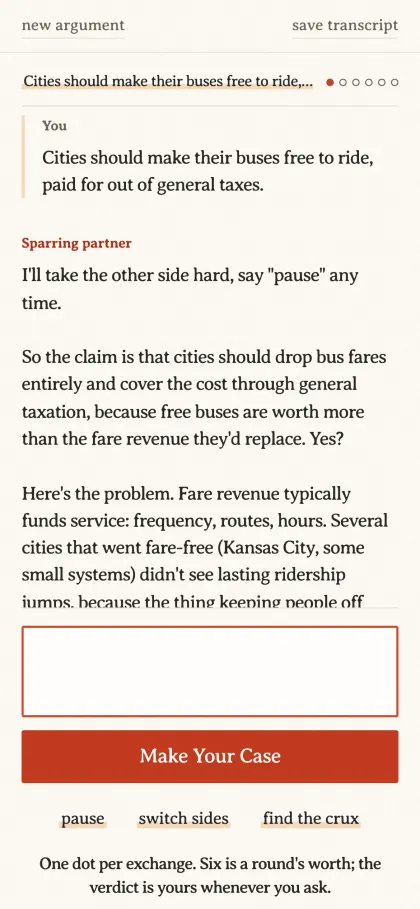
Restate, then object onceIt puts your claim back in its own words, then attacks the step your argument rests on. 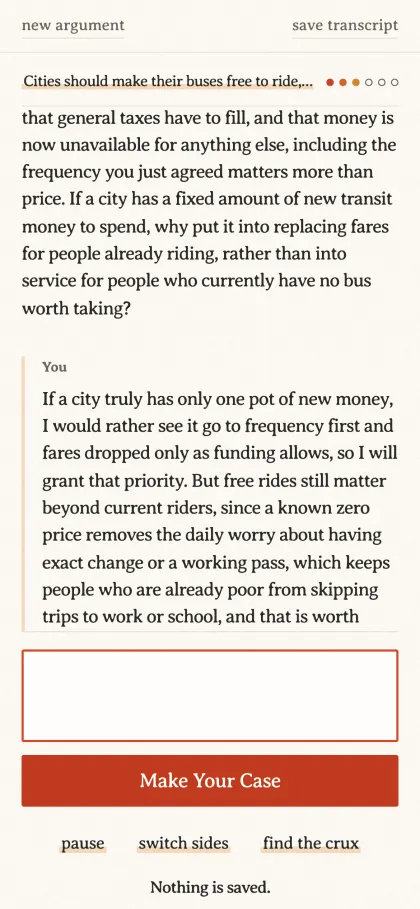
It climbsEach objection is harder, and aimed at the reason you just gave. 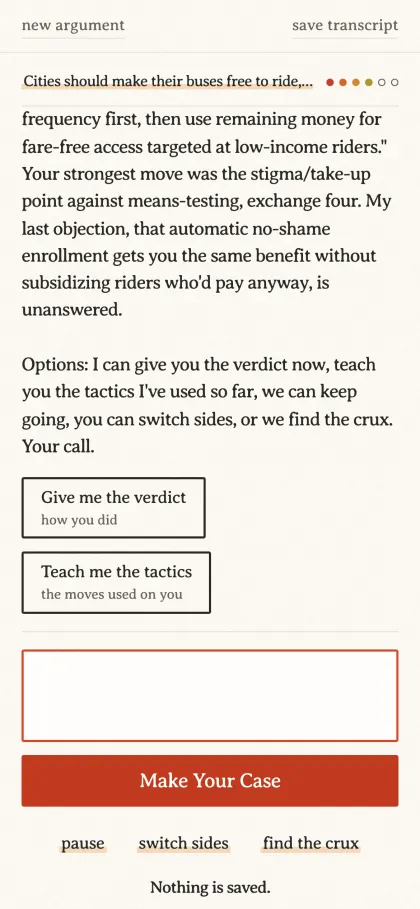
Pause any timeStep out, see where things stand, and choose what comes next.
Every Sparring partner line in this round is the product’s own, unedited. The visitor’s replies were written for the demo.
The way past an argument is through it.
Nothing here teaches you to de-escalate, soften, or find common ground. You’ll argue, and it will push back hard. Beyond argument means getting past the arguments you keep having, not getting out of them.
Find out how you actually argue.
Take a real position, defend it against real pressure, and get an honest debrief on what worked, what didn’t, and where you got moved for the wrong reasons.
It isn’t only about them.
You came here because of someone. A partner who reframes everything, a colleague who talks over the point, a friend who is never wrong. The training doesn’t work on them. It works on the part you control: what you’re actually claiming, where you get moved, and which of their moves you keep falling for. Most people find that’s the half that changes the conversation.
No score. No winner.
Nothing here grades you or tells you who won. A tool that scores you just teaches you to argue for the score. It argues whichever side you ask it to and keeps its own opinion out of it. Ask for the verdict and you get a straight read instead: whether your position was refuted or you were out-argued, where it turned, and one thing to work on.
Refuted, or just out‑argued?
The verdict from the same round, unedited.
Where you ended up. Not “buses should be free,” but “frequency should be funded first, and remaining money should go to free fares for low-income riders specifically.” A much narrower and more defensible claim than the one you opened with.
Where it turned. Exchange five. You argued, well, that means-testing causes stigma and missed take-up, which is true and well-evidenced. But I offered automatic no-shame enrollment (tied to existing records like SNAP or school rolls) as something that solves that exact problem without also funding fares for people who’d pay anyway. You hadn’t answered that when we paused.
The call. Out-argued, not shown wrong, on the universal-vs-targeted question. Your reason for worrying about means-testing stands; nobody touched it. You lost ground because you defended “universal” when your actual evidence (stigma, hassle) only supported “no visible means-testing,” which is a narrower and cheaper fix. Worth noticing: each time I pushed, you gave ground precisely and only where the objection landed, which is the opposite of folding.
One thing to work on. When you have a good reason, check what size of claim it actually proves before deploying it. “Stigma kills take-up” is a strong reason for automatic enrollment; it’s a weak reason for universal coverage. Next time, before answering, ask yourself whether your evidence supports the big version of your claim or only a smaller one hiding inside it.
What you did well. Your frequency concession, “free and frequent are not actually rivals, they can be funded together,” was you spotting that I’d framed it as a forced choice when it wasn’t fully one. That’s a real rebuttal, not a concession dressed up as one.
- Where you ended up
- The claim you were actually defending by the end, which is often not the one you started with.
- Where it turned
- The exchange where the round moved, and why.
- The call
- Shown wrong, out‑argued with your reason still standing, or held.
- One thing to work on
- One habit, with the question you could have asked.
- What you did well
- The move worth keeping.
It keeps nothing.
- No record of conversations
- No database, no storage of conversations, no cookies of its own, no analytics. Closing the tab destroys the transcript. Cloudflare keeps ordinary request logs for a few days; they never contain what you type.
- What reaches Anthropic
- What you type is sent to Anthropic to generate replies. Anthropic deletes it within 30 days and doesn’t train on it, except that a session its automated safety systems flag may be kept for up to two years.
- No sign‑up
- No account and no email address. Before your first message, Cloudflare Turnstile checks that this browser isn’t a bot.
Find out what you can actually defend.